
Bose SoundSport Free
Defining the First True Wireless Experience
Bose SoundSport Free marked Bose’s first step into true wireless earbuds—transforming an established wired sport platform into a completely new category. The challenge was to take a design originally built around two connected earbuds and re-engineer it into fully independent units, while preserving the stability, comfort, and performance users expected.
Working closely with cross-functional teams across electrical and mechanical engineering, we reconfigured the internal architecture—essentially integrating the full system of a wired product into each individual earbud. This required careful balance of component packaging, weight distribution, and form to ensure the earbuds remained secure during movement while still feeling visually cohesive and competitive in a rapidly evolving market.
To support a more premium positioning, the design focused on refinement and reduction. I explored ways to minimize part lines and simplify the overall construction, creating a cleaner and more resolved form. A key breakthrough was the introduction of an IMD (In-Mold Decoration) top cap with a three-layer film structure. This process added depth, richness, and a high-quality finish that elevated the product’s perceived value.
Beyond aesthetics, the IMD approach also enabled flexibility—allowing multiple colorways and special editions without new tooling, supporting regional customization and future variations. Combined with carefully tuned CMF decisions, the final design delivers a sporty, forward-looking expression that feels both durable and premium.
SoundSport Free represents a pivotal moment—where technical complexity, manufacturing innovation, and design refinement came together to define Bose’s entry into the true wireless category.

.jpg)
Design Process
Early in the SoundSport Free project at Bose, the primary challenge was rethinking the architecture inherited from the previous wired Bluetooth platform. Working closely with the electrical team, we explored how to consolidate components that once lived across two connected earbuds into a single, self-contained unit—evaluating new chipsets, battery configurations, and performance trade-offs to establish a viable system architecture. From there, I focused on refining the form through reduction: minimizing part count to create a cleaner, more modern expression while also improving cost efficiency. The design balances crisp, geometric exterior surfaces—aligned with the brand’s technical precision—with softer internal curvatures that feel more natural and comfortable against the human body, resulting in a form that is both engineered and empathetic.
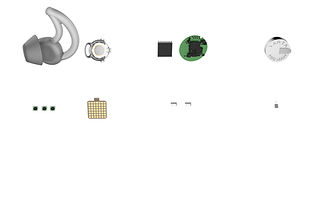


The second challenge focused on defining an intuitive user interface within a highly constrained form. Without the affordances of a traditional device, we had to rethink how users control core functions like play and pause directly on the earbud—balancing accessibility, feedback, and accidental touch prevention. At the same time, the interaction with the charging case became part of the overall experience. It wasn’t just a storage solution, but a key touchpoint for pairing, charging, and daily use. The goal was to create a seamless flow between earbud and case—where every interaction feels simple, predictable, and integrated into the product ecosystem.


After establishing the overall form, the next challenge was elevating the product to a more premium level. Through extensive exploration, I identified in-mold decoration (IMD) as the most promising direction. I worked closely with IMD vendors to understand the process, its constraints, and its creative potential. What stood out was the ability to layer films—either stacked on the surface or applied both above and below—creating a sense of depth and subtle visual shifting. This opened up opportunities for dynamic patterns and effects that change with light and viewing angle.
Another key advantage was the ability to achieve finishes—such as color shifting and iridescent reflections—that are difficult or impossible with traditional injection molding or paint. Building on these insights, I pushed into a series of explorations, developing multiple CMF directions that capture different expressions of the product—from refined and minimal to more expressive and trend-forward.


.jpg)
